
Influence real change with our immersive and expert-led LLB Law degree
Get ready to think on your feet, build strong arguments, and make life-changing decisions with a practical Law degree at Mary’s University, London.
You’ll dive into fascinating topics like criminal law, human rights, business, and family law while getting real-world legal experience. It’s your chance to learn how the law shapes every part of our lives – and start making a real impact.
Our course is a Qualifying Law Degree (QLD), so you can become a barrister through the Bar Professional Training Course (BPTC) or a solicitor through the Solicitor’s Qualification Exam route (SQE).
Why St Mary's?
The UK’s home of practical legal education
Working with legal professionals from day one
High-quality teaching from supportive experts
The UK’s home of practical legal education
On our LLB law degree, you’ll get real-world, practical experience, and exclusive volunteering opportunities that let you work on actual cases.
- Support through Court: Only at St Mary's London can you take clinical modules that see you working at the Royal Courts of Justice - one of Europe's largest courts - and the Central Family Court.
- Amicus: Make a difference protecting human rights. Our students have the opportunity to help real people facing the death penalty in the US. You’ll also gain training in US capital defence law and procedure, legal research, evidence, and professional conduct.
- At St Mary’s Law Clinic, you’ll collaborate with the leading law firm Hodge, Jones & Allen to analyse real legal problems and advise the local community.

Working with legal professionals from day one
As our Law degree is based in London, we’ll take regular field trips to prominent legal institutions in the capital, like:
- The Supreme Court
- Isleworth Crown Court
- The Houses of Parliament.
You’ll also attend exciting talks and workshops to build your network, understanding, and practical skills.
- We host a variety of guest speakers including Judge Connell (an Isleworth Crown Court judge), Sneh Aurora (the Executive Director of the Commonwealth Human Rights Initiative) who discussed the role of non-state actors in human rights, and practitioners who talk about becoming qualified lawyers.
- We also offer commercial awareness workshops to boost your employability.
Our wide range of assessment methods cover practical skills of lawyering to equip you in the job market. As a result, you’ll translate your learning to the courtroom and beyond. Plus, you’ll join the 96% of SMU students in employment, vocation, or further study within 15 months of graduation (HESA, 2024).
The support that students are offered is nothing short of excellent and I've really enjoyed working as a part of a smaller cohort.

Supportive and expert lecturers giving high-quality teaching
During your Law course, you’ll get clinical ‘real-world’ expertise, individual guidance, and consistent feedback to ensure you reach your full potential. Many of our lecturers are still practising in the UK and abroad, so they’ll teach and support you on current issues around non-governmental organisations (NGOs), mental health, domestic violence, and UN law – which you’ll be ready to tackle when you graduate.
We’re a small university, and Simmies (AKA St Mary’s students) feel valued here: lecturers will get to know you and be committed to your development. When you study law at St Mary's, you get:
- a personal tutor for academic support
- a pastoral tutor dedicated to your wellbeing
- learning and development lecturers to help you build solid study skills
- a university wellness team.
That's why 100% of our Law students say teachers are good at explaining things, and 96% say teachers have supported their learning well (National Student Survey, 2024).
Meet the law team at St Mary’s, London
My lecturers have played a significant part in guiding me as they go out of their way to help and provide guidance.
Get stuck in at our moot court
This summer we opened our permanent moot court on campus. This space provides our students plenty of opportunity to try their hand at mooting, negotiation, debating, client interviewing and presenting.
Mooting is when you'll take part in a mock court proceeding. You'll be arguing a hypothetical legal case in front of a judge. This will help you develop your critical thinking and public speaking skills.

Hear from law student Sophie
Academic support
in London (National Student Survey (NSS) 2025)Teaching quality
in the UK (The Sunday Times Good University Guide, 2025)Employability
of graduates are in employment, vocation or further study within 15 months of graduation (HESA, 2024)Career opportunities
With our LLB Law degree, you’ll be prepared for a variety of careers in law, and you'll have crucial transferable skills, including critical thinking, communication, and leadership.
96% of St Mary's students are in employment, vocation, or further study within 15 months of graduation (HESA, 2024).
When you start your course at St Mary's, you'll have access to our Career Services, which provides students and graduates with impartial advice on their career progression and development.
Some examples of job roles and areas of work for graduates of Law LLB (Hons) include:
Chat to us

Chat to us
Applying to university can be daunting, and you may have questions about applying, student life, or your course.
Course content
Modules on our LLB Law degree
These modules are the modules that were available to students in the 2025/26 academic year and are illustrative of what may be offered for 2026/27.
Please note: it is possible that a module listed on the website will not be able to run due to reasons beyond our control. For more information please refer to our course information disclaimer.
How the degree is taught
Teaching methods
Our LLB law degree is based at our beautiful and historic campus located in Twickenham, London.
The degree makes use of a wide range of learning and teaching strategies. Law is predominantly taught in a classroom environment through a combination of lectures, seminars, workshops, and tutorials.
Lectures are held weekly and provide a guide to a topic, highlighting important areas and providing information on matters that may not be readily available from other sources.
Seminars are normally held once a week for each module. The seminars provide opportunities for you to consolidate your learning.
Tutorials are provided for weekly and allow you to discuss a piece of prepared work, for example, a single problem question on a one-to-one basis. Tutorials will also be used as a way of providing feedback to draft plans and also completed assignments.
In addition to these formal sessions, you will be expected to organise meetings with other students in the form of study groups and to prepare for group assessments.
You will also have an opportunity to take part in field trips to the local courts.
We make extensive use of Moodle, the University’s virtual learning environment. It's used as a to share important information and resources and for encouraging learning engagement.
In the first year there is an emphasis on tutor-led learning, moving towards a greater degree of self-directed learning in the second year, culminating in a self-managed research project in the third year.
- Contact time
- 16%
- Independent study
- 84%
Assessment methods
Assessment types and criteria are clearly linked to the learning outcomes of course. Assessment criteria are used to ensure that you understand the knowledge and skills each assessment is seeking to develop.
We’ve removed the requirement for in-hall, written examinations, focusing more on practical assessment and workplace readiness. You'll encounter a variety of different assessment methods, each used to test your legal knowledge, skills and understanding:
- Reports
- Essays
- Oral assessments
- Work placement supervisor assessment
- Poster presentation
- Portfolio
- Practical legal skills
Feedback
We adhere to the university’s policy of providing feedback on assessments within 15 working days.
Who teaches this course?
Entry requirements
2026 and 2027 entries
Start date
Standard offer
112 UCAS points
Contextual offer
96 UCAS points
About Contextual Offer:
Not sure about your grades? We consider all factors when reviewing your application, as we know not everyone has the same support to reach their potential. So we may make a contextual offer below the standard Tariff if you meet our criteria. Read more about contextual offers.
Inclusiveness is one of our core values and we are committed to widening participation. We actively encourage applications from all students as we firmly believe that helping more people from a wide mix of backgrounds to access education contributes positively to individuals and society.
We understand that sometimes barriers you can't control get in the way of academic achievement. You are more than just your grades. We'll consider your application as a whole, taking into account things like:
- subjects studied at Level 3
- your GCSEs (or equivalent) profile
- non-academic achievements you mention in your personal statement
- your references and motivation.
Fees & funding
September 2026
Home
£9,790
International
£17,445
*Please note: Tuition fee increases for undergraduate Home students are subject to regulatory control by the UK Government. The above Home fees for September 2026 are confirmed by the UK Government subject to Parliamentary procedure in early 2026. These fees are annual and may increase as detailed in our tuition fee variation disclaimer.
For more information on foundation year fees for home students, please check the details on our tuition fee page.
For more information about whether you are likely to pay home or international fees, please visit our 'understanding your tuition fee status' page.
Information about tuition fees, student loans, and funding your studies can be found within our fees and funding section.
Scholarships
Find out more about our range of scholarships and bursaries available to undergraduate students.
Living costs
A guide to your living costs has been created by our Student Funding Team.
Accommodation costs vary depending on whether you opt for an en suite room and on-site catering. Take a look at our accommodation options and the prices you can expect to pay.
Apply now
If you're currently living in the United Kingdom and Ireland, you'll need to apply directly through UCAS. You can check our step-by-step application guide for detailed information. You will also need to apply directly if you want to study any course part-time.
If you're an international student and you would like to apply for Foundation and Placement Year courses, you can submit an application directly or add St Mary's University as a choice on UCAS. Check our guideline for more information.
September
Transferring from another institution?
St Mary's is happy to consider applications from students who wish to transfer from another university. If this is you, please follow these instructions.
You may also be interested in:
More from St Mary's
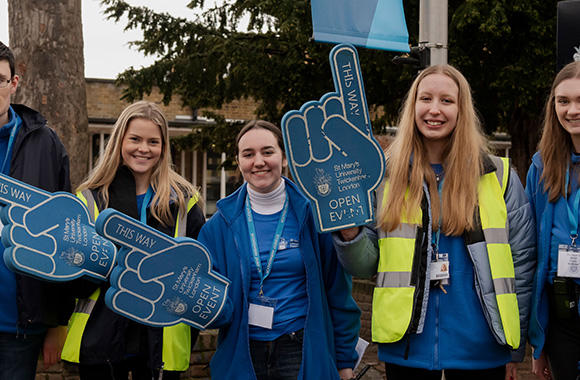
Thinking about whether St Mary's is the right place for you? Come and visit it us on campus.

Find out more about the extensive support system available to you at St Mary’s.

Discover the many areas in which our academies are currently researching.

Discover what life is like on our London campus.