
Making healthcare available online does not automatically make it accessible. For migrant communities, barriers can arise at every stage of the journey – from registering with a GP to understanding a referral, trusting a service or getting the support needed to access care.
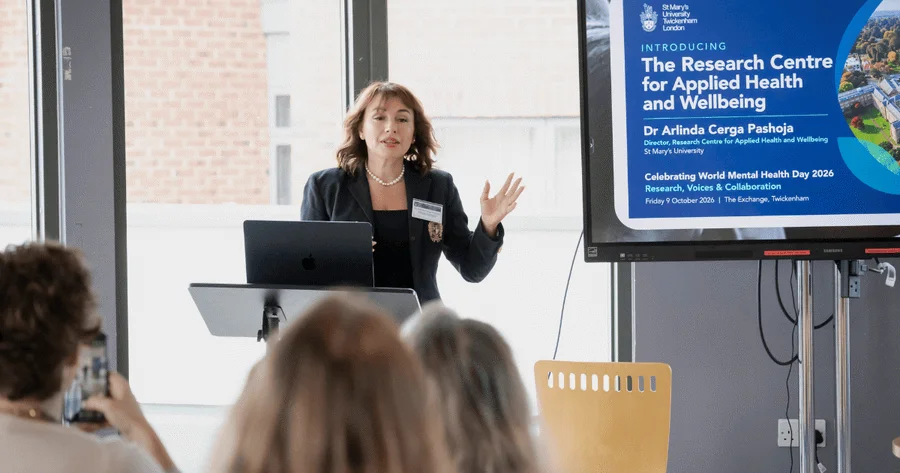
This was one of the central messages of our recent event, Celebrating World Mental Health Day 2026: Research, Voices & Collaboration, at The Exchange in Twickenham last week. The event brought together researchers, healthcare professionals, policymakers, community organisations and people with lived experience to explore how research and collaboration can lead to meaningful improvements in health and wellbeing.
It also marked the launch of our new and our policy White Paper, .
Digital access is about more than technology
As healthcare services increasingly move online, it is tempting to think about digital inclusion primarily in terms of internet access, devices or digital skills. These matter, but they are only part of the picture.
Our research into digital pathways to primary and mental healthcare for migrant communities in London highlights the need to consider the whole healthcare journey. A service may exist online, but that does not mean someone can easily register, understand the information provided, navigate the next steps or access the care they need.
Language and cultural differences can create barriers. So can a lack of trust or uncertainty about how personal information will be used. Providing a link to a service is not necessarily enough if someone does not know what to do next or does not feel confident using it.
These are not simply technical problems. They are questions about how healthcare services are designed, communicated and delivered – and whether they reflect the experiences of the people who need them.
Understanding people's experiences
Some of the most thought-provoking contributions at our World Mental Health Day event came from people reflecting on the realities of accessing and delivering healthcare.
, a systemic therapist, spoke about how experiences of authority can remain with people long after they have arrived in a new country. As they put it, “a uniform is still a uniform”. For migrants, refugees and people seeking asylum, the uniform of a healthcare professional may carry associations shaped by previous experiences with authority in their country of origin. This is a reminder that building trust requires more than providing a service: it means understanding the experiences people bring with them.
, Head of Refugee Services at , highlighted that migrant communities cannot be treated as one homogeneous group. Someone arriving from Ukraine may have very different experiences, circumstances and support needs from someone arriving from Afghanistan. If services are to be accessible, they must recognise these differences rather than assume that a single approach will work for everyone.
The discussion facilitated by highlighted the burden that can fall on family members when healthcare systems are difficult to navigate. Dr , postdoctoral researcher and second-generation migrant, spoke about the responsibility of translating information and completing forms when helping her parents access healthcare. That responsibility, she argued, should not fall on family members by default. Services need to take responsibility for making information understandable and providing appropriate support.
These experiences illustrate why digital access cannot be measured simply by whether a website, online form or appointment system exists. We also need to ask who is expected to navigate it, what support is available and whether the service recognises the circumstances of the people using it.
From policy on paper to change in practice
Another discussion, facilitated by , also highlighted the challenges faced by the professionals trying to improve access.
, a GP and Professor of Primary Care at , reflected on how barriers can arise at every stage of the healthcare journey. Even when policies set out positive ambitions, financial pressures and limited resources can prevent professionals from delivering the services they want to provide. There is a risk that good intentions remain on paper rather than translating into meaningful change.
This matters because accessibility cannot be achieved through policy commitments alone. Organisations need practical ways to identify where people encounter barriers, understand what is possible within their resources and make improvements that have a real impact.
Our White Paper, Availability Is Not Accessibility, sets out nine recommendations to help improve digital pathways to primary and mental healthcare for migrant communities. These include making GP registration hybrid by default, supporting community-based digital navigation, strengthening multilingual access and improving communication about confidentiality and entitlements.
The accompanying migrant-inclusive digital pathways Toolkit is intended to help GP practices, Talking Therapy services, community organisations and other stakeholders assess their services and identify practical improvements.
There is no single solution that will remove every barrier. Progress requires organisations to understand where people are encountering difficulties, work with the communities affected and identify changes that can be implemented in practice.
It also requires collaboration. Researchers can generate evidence, healthcare professionals understand the realities of service delivery, community organisations bring valuable relationships and insight, and people with lived experience can help identify what meaningful access looks like. Bringing these perspectives together offers a stronger basis for change.
Building healthier, more inclusive systems together
The launch of St Mary's Centre for Applied Health and Wellbeing provides an opportunity to strengthen the connections between research, policy, professional practice and communities.
The challenges discussed at our event extend beyond digital healthcare. They raise broader questions about how we ensure services respond to people's needs, how lived experience informs decision-making and how evidence can be translated into improvements that make a difference.
For me, the central message is simple: we should not judge a service's accessibility by whether it exists, but by whether people can actually use it to get the support they need.
Digital transformation has the potential to improve healthcare, but accessibility, trust and human support must be part of that transformation from the outset.
If we want research to make a difference, we need to work across sectors, listen to the people most affected and turn what we learn into practical action.
Explore the research and opportunities to collaborate
- Read and explore the accompanying resources.
- Find out more about the .
- St Mary's staff and students can .
- External organisations can .
Study psychology at St Mary’s
How essential services are delivered is constantly changing. These services need people who have a scientific understanding of human experience to ensure they’re delivered in a way that people who need them most can actually use them.
That’s why our psychology courses apply social psychology to real-world problems and current events, so our students have the skillset to make an impact.
is an Associate Professor in Psychology. She is a prominent researcher in global mental health, leading three global studies to enhance mental health across Europe and Australia.