
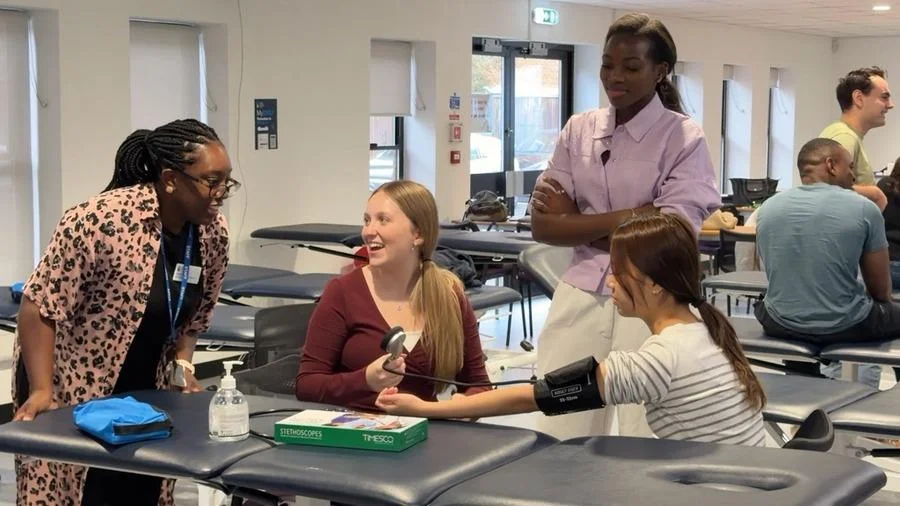
From taking a patient's blood pressure to managing a medical emergency, medical simulation helps future doctors develop practical skills, clinical judgement, and confidence before putting their learning into practice with real patients.
Imagine walking into a hospital room. A patient is struggling to breathe. The monitor is alarming, their condition is deteriorating, and someone turns to you and asks, "What do we do next?"
It's the sort of situation that can unfold in an Emergency Department, where decisions sometimes need to be made quickly, often with incomplete information. Importantly, something similar can happen in a different setting, even while on a flight!
Now imagine being able to pause that moment, discuss what went well, identify what could have been done differently, and encounter the situation again.
That is one of the real strengths of medical simulation.
Working across Emergency Medicine and medical education offers an interesting perspective on how we prepare students for clinical practice. What happens in a teaching room may seem very different from what happens in a busy hospital setting, but the connection between the two is important.
Medical simulation allows students to practise clinical skills, make decisions, communicate with patients, and learn from experience in a supervised environment.
But what does that actually look like, and how does it help prepare someone to become a doctor?
Medical students spend years developing their understanding of anatomy, physiology, disease and treatment. That scientific knowledge is essential. But knowing what to do and being able to do it, aren't quite the same thing.
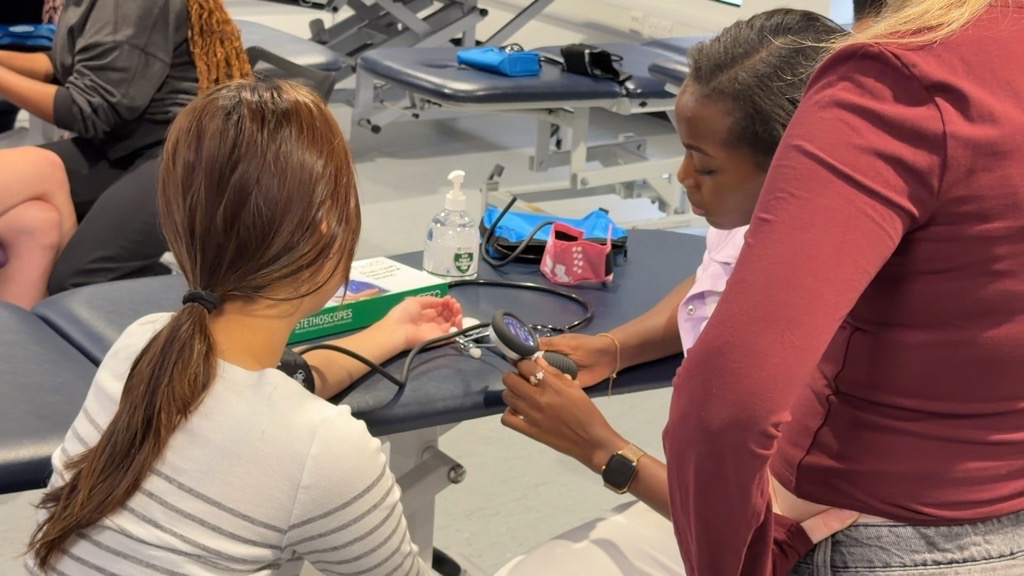
Take something as familiar as measuring a patient's blood pressure. It sounds straightforward, but a student needs to select the appropriate equipment, explain the procedure, position the patient correctly, obtain an accurate reading, and understand what that reading means.
Now add a patient who is anxious, uncomfortable or finding it difficult to communicate.
Suddenly, a relatively simple clinical task involves several skills working together.
This is where clinical skills education becomes so important.
Students need opportunities to practise taking medical histories, examining patients, performing procedures, communicating effectively, and recognising when someone may be becoming seriously unwell.
Good medicine isn't simply about doing things correctly. It's about doing the right things, for the right patient, at the right time.
That takes knowledge, judgement, communication and practice.
How medical simulation helps students practise clinical skills
When people hear the word simulation, they sometimes imagine a sophisticated mannequin connected to monitors, surrounded by expensive technology.
That is certainly one form of healthcare simulation, but the reality is much broader.
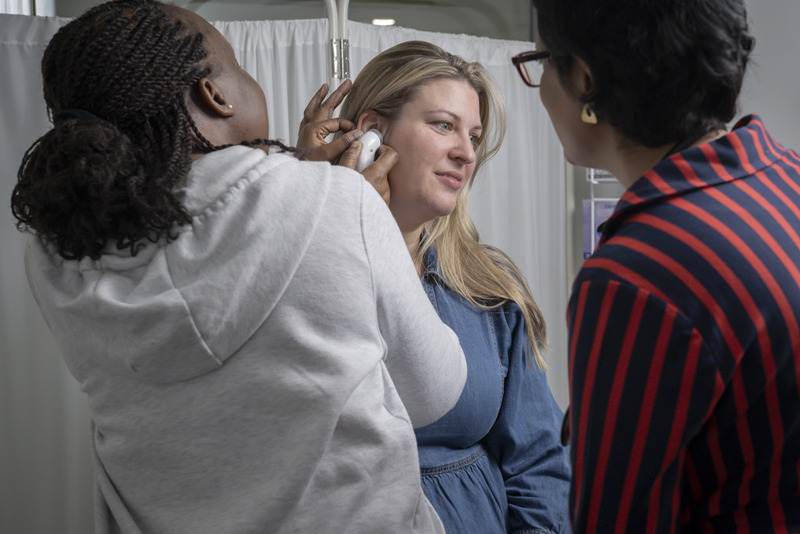
A student might practise giving an injection using a training model. Another might learn how to examine a patient or take a medical history. A group might work with a trained simulated patient to practise explaining a diagnosis or discussing a treatment plan.
In other sessions, students may encounter a realistic clinical scenario where a patient's condition changes and they have to decide what to do next.
The environment is controlled, but the learning is purposeful.
Consider a student assessing someone with chest pain.
They need to introduce themselves, establish what's happening, ask appropriate questions, and recognise potentially serious symptoms. They may need to perform observations, interpret information, and communicate their findings to another member of the healthcare team.
Throughout the exercise, an educator can observe not just what the student knows, but how they apply that knowledge.
Did they listen carefully? Did they recognise important warning signs? Could they explain their thinking? Did they know when to ask for help?
These are the behaviours that matter in clinical practice.
Medical simulation allows students to develop them progressively, with supervision and feedback appropriate to their stage of training.
Why making mistakes can be part of learning
An emergency rarely arrives as a neat textbook question. Patients don't always present with classic symptoms, and the most important information might not be immediately obvious.
That uncertainty is something medical students need to learn to manage.
Simulation offers a valuable opportunity to encounter uncertainty, make decisions, and learn from mistakes without compromising patient safety during the exercise.
A student may overlook an important observation, forget to clarify a symptom, or struggle to organise their assessment.
Rather than treating every mistake simply as a failure, educators can use it to understand how the student was thinking and what they need to develop.
One of the most important parts of a simulation session often happens after the scenario has finished. This is called debriefing.
The educator and learners discuss what happened, why decisions were made, and what might be approached differently next time.
Sometimes the most useful question isn't, "What did you get wrong?" but, "What were you thinking at that moment?"
Understanding why a student made a particular decision is often where the most useful learning begins.
This reflects an important educational principle known as deliberate practice: developing skills through focused, repeated practice, supported by feedback and opportunities to improve.
Research into simulation-based medical education has consistently highlighted the importance of feedback, repeated practice and clear learning objectives. An influential systematic review by Issenberg and colleagues identified these as important features of effective simulation-based learning.
Of course, simulation doesn't replace real life clinical experience. Students must also learn through supervised encounters with patients and healthcare professionals.
The two approaches complement one another. Simulation provides opportunities to prepare, practise and reflect, while clinical placements allow students to apply their learning in real healthcare settings.
The human side of learning clinical skills
One of the interesting aspects of medical education is that we can teach a student the technical steps of a procedure, but that doesn't automatically teach them how to put a patient at ease.
Imagine two students performing the same examination.
Both follow the correct clinical sequence. Both identify the relevant findings.
But one explains what they are doing, checks whether the patient is comfortable, and responds to their concerns. The other concentrates so intensely on remembering the examination steps that they barely acknowledge the person in front of them.
Technically, their performance may appear similar. From the patient's perspective, the experiences could be very different.
This is why communication, professionalism and compassion must develop alongside practical clinical skills.
Working with simulated patients can be particularly valuable here. Students practise conversations with people trained to portray clinical situations and provide feedback on how the interaction felt.
Did the student listen? Did they use understandable language? Did they allow time for questions? Did they recognise the patient's concerns?
These qualities are central to good medical practice. They also reflect the General Medical Council's Outcomes for Graduates, which sets out the professional values, knowledge and skills expected of newly qualified doctors in the UK.
Can technology make medical simulation better?
Technology is creating interesting opportunities in healthcare simulation and medical education.
Virtual reality can allow learners to explore clinical environments and practise decision-making. Augmented reality can help students visualise anatomy and clinical information in ways that may be difficult to reproduce in a textbook. Students can now speak to virtual patients and we can use that to practice communication skills even before they encounter a real patient.
Artificial intelligence is also beginning to influence how educational scenarios are developed and how learners interact with simulated clinical situations.
Having explored immersive technologies in clinical education, I find the most important question isn't simply what the technology can do, but whether it genuinely improves learning.
Does it help students understand something more clearly? Does it create opportunities for meaningful practice? Does it support feedback, reflection or clinical reasoning?
A sophisticated simulation isn't automatically an effective one. Sometimes a straightforward conversation with a simulated patient, followed by thoughtful feedback, can be more educationally valuable than an elaborate technological experience.
Technology should serve the learning, rather than the other way around.
And however advanced our educational tools become, they can't remove the importance of human connection in healthcare.
Medical simulation at St Mary's
At St Mary's University School of Medicine, clinical skills and simulation are important elements of preparing students for clinical practice.
The educational aim is to connect scientific understanding with practical skills, professional judgement and compassionate care, helping students appreciate not just what they are learning, but why it matters to patients.
This means thinking carefully about how learning activities are designed, how students are supported to practise, and how their progress is assessed.
One example is the Objective Structured Clinical Examination, commonly known as an OSCE, where students demonstrate clinical and communication skills through a series of practical stations.
An OSCE might ask a student to take a focused history, perform an examination, explain a procedure, or respond to a clinical situation.
These assessments are not simply tests of memory. They provide structured opportunities to evaluate how students bring their knowledge and skills together.
There is an important relationship between teaching, practice, feedback and assessment. Students should understand what they are expected to learn, have opportunities to develop those abilities, and receive feedback that supports their progress.
Becoming clinically competent is a gradual process. A first-year medical student isn't expected to function like an experienced doctor.
What matters is building strong foundations, encouraging curiosity, developing sound habits, and supporting increasing independence as knowledge and experience grow.
This is central to how we think about clinical skills education: preparing students not simply to complete an assessment, but to continue developing the capabilities they'll need throughout their medical careers.
Preparing for the moments that matter
In clinical practice, patients meet us at moments when they may be frightened, vulnerable or uncertain about what is happening.
They need clinicians who are knowledgeable and technically capable. But they also need people who can listen, explain, recognise their limitations, and make thoughtful decisions.
Those qualities don't appear overnight.
They develop through learning, observation, supervised practice, feedback and experience.
Medical simulation is one part of that journey. It creates space for students to ask questions, make decisions, practise clinical skills, and learn from situations they may one day encounter in clinical practice.
Perhaps that's the most useful way to think about it.
We aren't trying to recreate every moment of a doctor's working life in a classroom. We're helping students develop the knowledge, skills and judgement they need when those moments arrive.
Studying Medicine at St Mary's
At St Mary’s University London School of Medicine, clinical skills and simulation are part of the MBBS from Year 1. Students learn alongside experienced clinicians like Dr Stephen Ojo, who brings his Emergency Medicine practice into the teaching room. Early NHS and community placements, small-group teaching and personalised support help students build the knowledge, judgement and confidence to become the kind of doctor patients need when it matters most.