
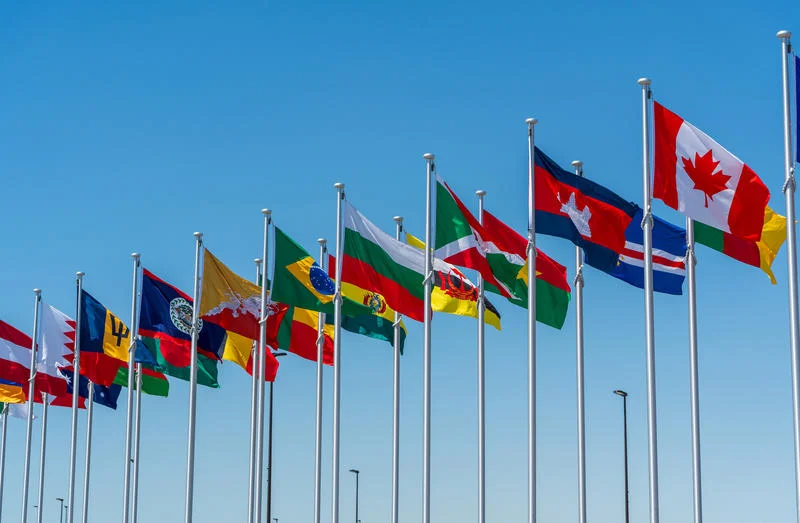
Should it matter which country a footballer chooses to represent? In this blog, St Mary's law lecturer Matthew Rowledge explores the debate around national team eligibility at the 2026 FIFA World Cup – and asks why we accept freedom of movement at club level but continue to question it on the international stage.
Amidst the constant conversations around squad selections, team tactics, and hydration breaks, another rhetoric that has resurfaced during the 2026 FIFA World Cup is about the eligibility of players for their national teams based on their birth country.
While football has long accepted that players can move freely between clubs, when players make choices about which nation to represent the conversation often becomes far more contested.
At a time when questions of belonging, migration, and national identity are increasingly prominent in public debate, international football offers a revealing lens through which we examine our understanding of heritage, representation, and who gets to “belong” on the world stage.
Freedom of movement in club football
The 1995 ruling in ‘Belgian Football Association v Bosman (C-415/93)’, affectionately known as the ‘Bosman Rule’, became instrumental in our understanding of freedom of movement in club-level football.
It enabled players to explore alternative clubs once their contract had expired, essentially as a fee-free transfer. This was celebrated by clubs and fans with several prominent player movements benefiting from this ruling, although some have been controversial such as Sol Campbell from Tottenham Hotspur Football Club to Arsenal Football Club .
This freedom for players to decide which team they play for, provided they meet the necessary right-to-work and immigration requirements, is now not only accepted but settled as a matter of public discourse.
Diaspora identity in national football
However, the same cannot be said on an international level.
When considering eligibility of players to represent nations in football, we must acknowledge players do so within the confines of the FIFA Regulations Governing the Application of the Statutes, Articles 5-8. Invariably, questioning of these articles regarding diaspora identity and national team representation is somewhat framed as whether nations are obtaining an ‘unfair’ competitive advantage. This is largely historically considered in respect to the Netherlands and France, but more recently includes Morocco after their 2022 World Cup success.
The media narratives questioning either the players themselves or FIFA regulations seem to be selective in my opinion. Seldom has it been reported that within Thomas Tuchel’s initial 26-man squad, 20 players were eligible to represent other nations. Both Declan Rice and, historically, Jack Grealish have previously represented the Republic of Ireland (ROI) at international level.
In fact, reporting on Chris Birchall, an English-born, white footballer, representing Trinidad and Tobago at the 2006 World Cup, was largely celebrated within mainstream media. More recently, there has been a romanticising of Roberto Lopes, a ROI-born player recruited to play for the Cabo Verde National Team via LinkedIn.

Belonging and a distinct national identity
With increased right-wing, anti-immigration rhetoric, it is surprising that there is continual questioning of players who choose to represent a team where they feel a greater sense of belonging.
Such talking points were prevalent in the reporting of Ayyoub Bouaddi’s choice to represent Morocco at a senior level. Despite being French-born and representing France at junior levels, he identified that his Moroccan heritage is important to him; wearing Moroccan national team shirts when he was 10 years old and being brought up in a household of Moroccan parents.
Issues here run far deeper than which nation a player chooses to represent. Recent commentary from Restore Britain’s spokesperson, Charlie Downes, has mandated a return to indigenous British ancestry. Whilst presently a fringe political party, these words underpin many of the themes we see in articles regarding which nation players should represent.
In England’s case, what is indigenous ancestry? After the Ice Age, the country was mostly repopulated by emigration from Spain and Portugal, then Anatolia (modern-day Türkiye). Then came an increase in population from Bell Beaker people from the Pontic Steppe. There have also been varying ranges of people who ruled Britain (including the Celts, Romans, Anglo-Saxons, Vikings and Normans) who brought people to England from their respective empires, reaching as far as North Africa and the Middle East.
So, can we really say that we have a distinct national identity and who is qualified to represent us at major sporting tournaments?
Where do we go from here?
Why can we accept the fluidity of chosen representation at a club level, but the national level is continually challenged? Should we not rejoice that we have individuals who want to represent a particular nation, irrespective of their nation of birth?
Inherently built within these choices is a sense of belonging. Representing your chosen nation is a moment of pride, something we should be applauding as a collective. None of these individuals are operating contrary to any rules.
Global events like the World Cup are designed to bring us together to celebrate athletes and the nations they represent. An acknowledgement that our differences are not what divide us but open the door for us all to have a deeper understanding of one another’s cultures. Is this a shared experience of positivity we can all embrace?
Whilst many will believe their questioning is innocent, we must take heed from the ruling in R (E) v Governing Body of JFS [2009], in which the school's admission policy amounted to unlawful race discrimination, and ensure such questioning remains one of educational dissemination rather than race-based critique.
Interested in Law?
Matthew Rowledge is a Lecturer in Law at St Mary's University, specialising in employment law, human resources management, and the tort of negligence. He brings many years of industry experience to his teaching, combining legal and business expertise to help students achieve their career aspirations.
At St Mary's, we offer undergraduate and postgraduate Law degrees taught by academics with real-world professional experience, preparing graduates for careers across the legal sector and beyond.