
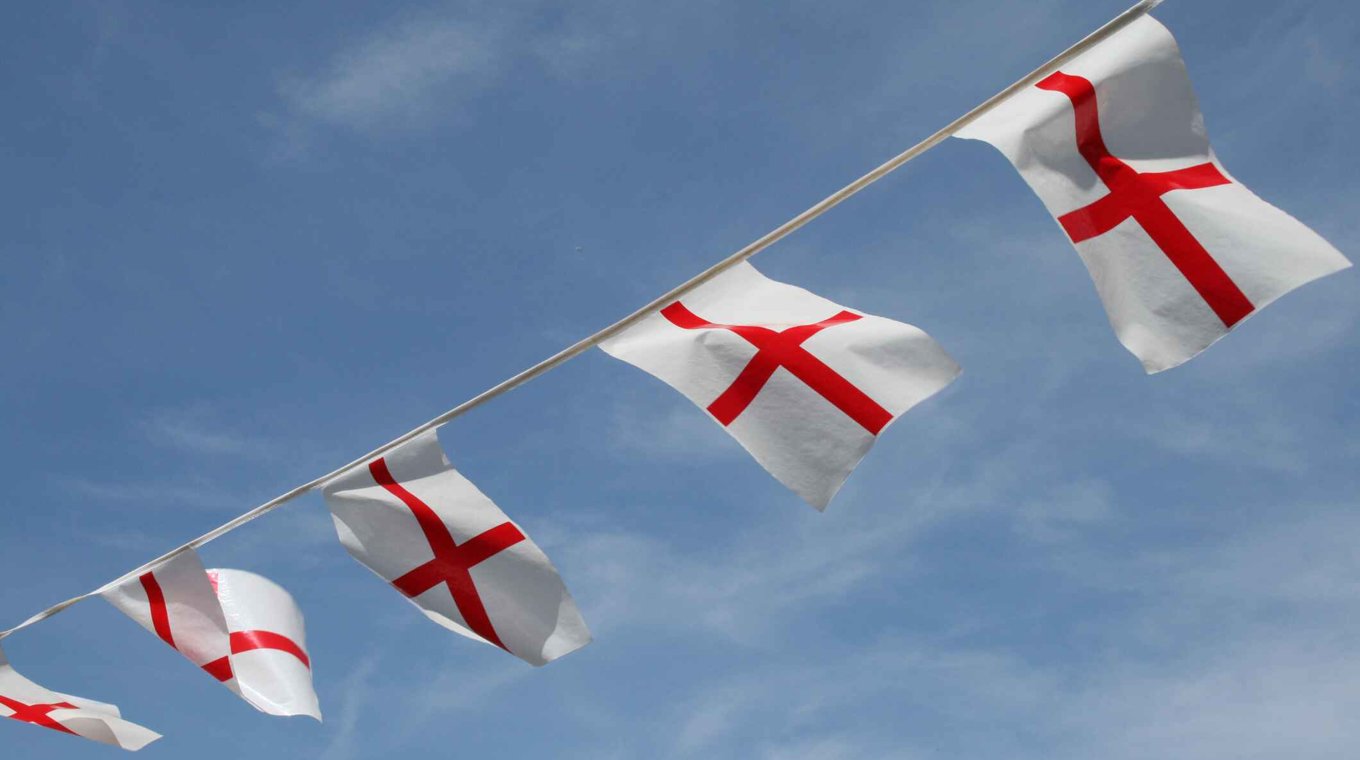
Each year, St George’s Day invites reflection on England’s past - its symbols, its traditions, and its sense of national identity. The red cross, the dragon-slaying saint, the idea of a shared English story: all feel deeply rooted, almost timeless.
But much of this symbolism is less ancient than it appears. In fact, it was carefully shaped at a moment of profound political uncertainty - by a dynasty that understood the power of image as well as any modern government.
The Tudors did not simply inherit England’s identity. They rebuilt it.
When Henry VII came to power after the Battle of Bosworth Field, he faced a problem familiar to many rulers throughout history: how to make authority appear natural when it is, in fact, newly won. His claim to the throne was fragile, his support uncertain, and the memory of civil war still fresh.
The solution was not just political consolidation, but symbolic reinvention.
The now-familiar Tudor rose - uniting the houses of York and Lancaster - was a deliberate creation, designed to present division as harmony and conflict as resolution. It was a powerful visual shorthand for a simple message: that England’s troubles were over, and that Tudor rule represented continuity rather than rupture.
But if the Tudor rose spoke of unity, Saint George offered something equally important: a language of authority.
Under the Tudors - especially Henry VIII - St George was not merely venerated; he was strategically elevated. Already associated with the crown through the prestigious Order of the Garter by Edward III, the saint embodied ideals of chivalry, divine favour, and martial strength. These were not abstract virtues. They were precisely the qualities the Tudor monarchy needed to project.
What made St George so useful was his adaptability. In a period marked by shifting alliances abroad and religious upheaval at home, he provided a symbol that could bridge old and new. He was recognisably traditional, yet politically flexible - a figure who could anchor the monarchy in continuity while supporting its transformation.
This became particularly important during Henry VIII’s break with Rome. As England moved away from papal authority, the monarchy required new ways to frame its legitimacy. St George – now regarded as an English saint, tied to crown rather than Pope - offered a powerful means of doing so. Through ceremony, imagery, and court culture, the king aligned himself with the saint’s heroic narrative, subtly presenting his own rule as both divinely sanctioned and nationally rooted.
This was not accidental. It was political strategy.
Royal power in the early modern period depended as much on perception as on policy. The Tudors understood that authority had to be seen, staged, and repeated. Tournaments, court rituals, diplomatic encounters - all became theatres in which monarchy was performed. The famous Field of the Cloth of Gold, for example, was not simply an extravagant meeting between kings. It was a carefully orchestrated display designed to position England as an equal player on the European stage.
In that context, symbols like St George were not inward-looking. They were outward-facing signals - part of a shared language of monarchy and power that extended across Renaissance Europe.
This is what makes the Tudor use of symbolism feel strikingly modern. Their approach was not about preserving tradition for its own sake, but about selecting, refining, and amplifying the symbols that best served their political needs. In effect, they curated a version of English identity that could stabilise a new dynasty and elevate its status at home and abroad.
Seen in this light, St George’s Day is not simply a celebration of heritage. It is also a reminder that national identity is, at least in part, constructed.
The symbols we associate with England - its saints, its emblems, its stories - did not emerge unchanged from the distant past. They were shaped in specific historical moments, often with clear political purposes. The Tudors understood this well. They recognised that power lies not only in ruling a nation, but in defining how that nation understands itself.
That insight has lost none of its relevance. Today, as in the sixteenth century, identity is still negotiated through symbols, narratives, and carefully crafted images. The mediums may have changed, but the principle remains the same.
Power is not only exercised. It is performed.
History at St Mary's University
Glenn Richardson is Professor of Early-Modern History at St Mary's University, London. A Fellow of the Royal Historical Society and President of the Society for Court Studies, he has published widely on Tudor monarchy and Renaissance Europe, including The Field of Cloth of Gold, and Renaissance Monarchy: The Reigns of Henry VIII, Francis I and Charles V.
If you're interested in studying the politics, culture, and power of the past, explore and learn from researchers shaping the field.