

Balancing it all as a student can be challenging. In this blog, St Mary's Student Ambassador Liliana shares some helpful time management strategies.
University life is exciting, but it can also feel like a constant balancing act. Between attending lectures, completing assignments, preparing for exams, working a part-time job and maintaining a social life, it's easy for students to feel like they are being pulled in multiple directions at once.
When studying at St Mary's, you'll likely be managing a combination of academic commitments, extracurricular activities, placements, sports clubs and personal responsibilities throughout the year. The good news is that effective time management is a skill that can be learned, practised and improved over time.
This guide explores practical time management tips for students, from creating a realistic schedule and prioritising tasks to using digital tools effectively and balancing study with work. By building a few simple habits, you can reduce stress, improve your academic performance, and make more time for the things you enjoy.
Why students need to manage their time effectively
Managing time as a student is about much more than simply getting through a to-do list. When you have a clear plan for your week, you're less likely to feel overwhelmed by competing deadlines and last-minute pressure.
Students who manage their time effectively often experience lower stress levels because they are not constantly trying to catch up. Assignments can be started earlier, revision can be spread over several weeks rather than crammed into a few days, and unexpected challenges become easier to handle.
Time management can also have a direct impact on academic performance. Creating dedicated study periods allows you to engage more deeply with course material and submit higher-quality work. Rather than rushing an assignment the night before it is due, you can work steadily and give yourself time to review and improve your work.
Beyond academics, strong time management skills can contribute to better wellbeing. Making space for exercise, social activities, hobbies and rest helps create a healthier university experience. It's also a valuable skill that employers consistently look for in graduates. Learning how to prioritise tasks, meet deadlines, and manage competing responsibilities now will benefit you throughout your career.
Build a visual schedule that actually works
Map your fixed commitments first
There's nothing worse than accidentally double-booking yourself: the best way to start planning your schedule is to start with your commitments that cannot easily be moved. Before planning anything else, start by mapping out your lectures, seminars, placement hours, work shifts, sports training, society meetings and any other regular activities that tend to take place at roughly the same time each week.
Use a digital calendar or a paper planner to block out these fixed commitments first so that you have an accurate picture of your schedule. Seeing your week laid out visually makes it easier to understand how much time you genuinely have available. Many students underestimate how busy they are until they see everything in one place. Once your non-negotiable commitments are visible, you can build a more realistic study plan around them.

Create study blocks around your peak focus times
Not everyone works best at the same time of day. Some students are at their most productive first thing in the morning, while others find they concentrate better in the evening. For me, I’ve always found myself the most productive during the late morning, after I’ve eaten breakfast and given myself time to properly wake up.
Pay attention to when you naturally feel most focused and alert. Reserve those periods for your most demanding work, such as essay writing, exam revision, or reading complex academic texts. Less demanding tasks – such as organising notes, responding to emails, or updating your calendar – can be completed during lower-energy periods.
Working with your natural energy levels can significantly improve productivity and make studying feel less exhausting.
Protect time for life, not just study
A common mistake among students is filling every available hour with academic work. While dedication is important, a schedule that leaves no room for rest or enjoyment is rarely sustainable.
Make sure your timetable includes time for seeing friends, exercising, pursuing hobbies, and simply relaxing. Building regular breaks and downtime into your week helps prevent burnout and makes it easier to maintain motivation throughout the academic year.
Techniques to prioritise and manage your study time
1. Try to prioritise with the Eisenhower Matrix
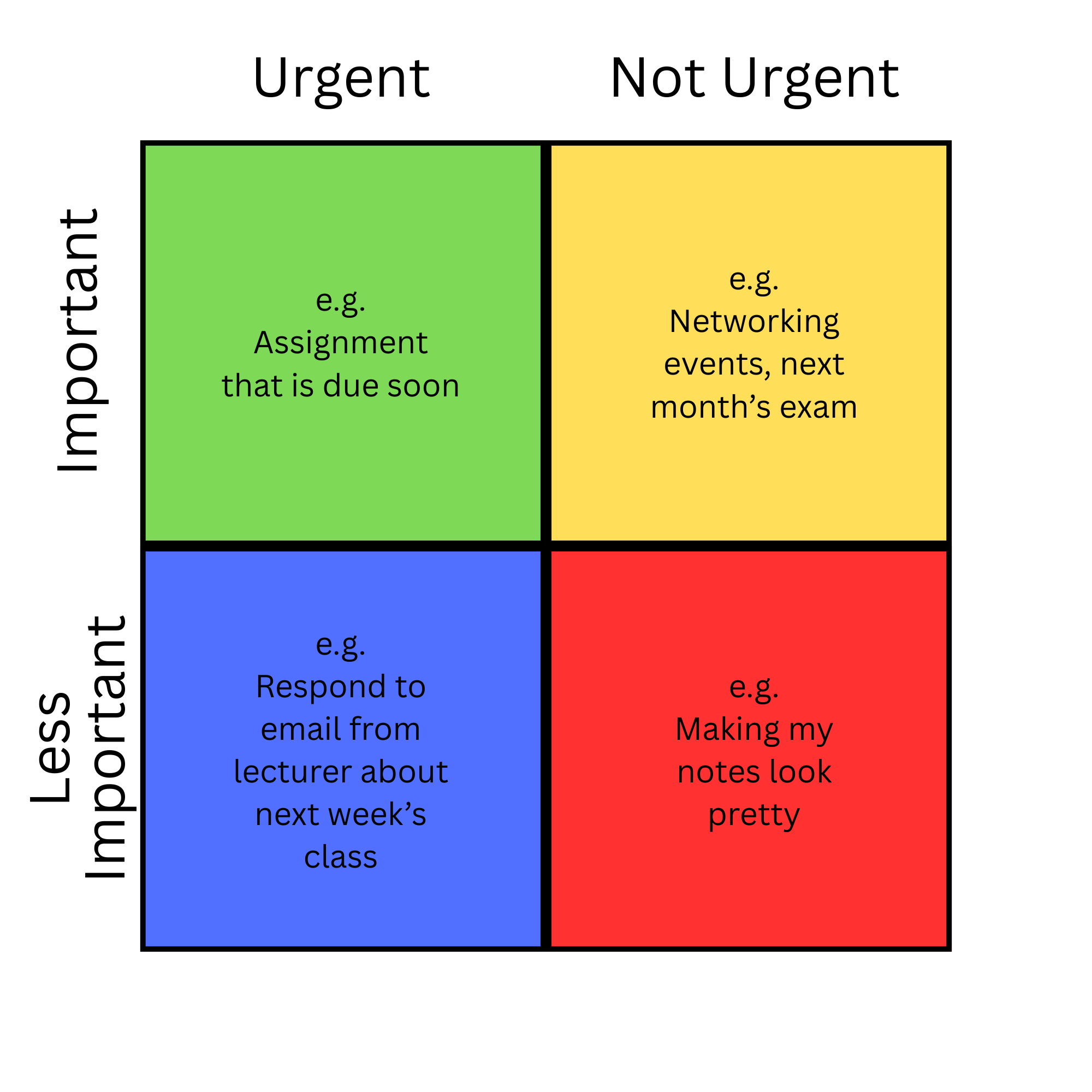
The Eisenhower Matrix is a simple framework that helps you decide which tasks deserve your attention first. It divides tasks into four categories based on urgency and importance.
Tasks that are both urgent and important should be completed immediately. Important but non-urgent tasks should be scheduled into your calendar. Urgent but less important tasks can often be completed quickly or set as a task for after you've finished an urgent and important task, while tasks that are neither urgent nor important can usually be eliminated.
For example, preparing for an exam next month may be important but not yet urgent, while an assignment due tomorrow is both important and urgent.
The framework can be particularly useful during busy assessment periods when everything seems equally important. Here's an example of how the matrix can work:
2. Break big assignments into smaller steps
Large projects can feel intimidating when viewed as a single task. A dissertation, group project or major coursework submission often involves multiple stages that are easier to manage when broken down.
Instead of writing "Complete dissertation" on your to-do list, create smaller tasks such as:
- Select research topic
- Conduct literature review
- Create outline
- Write introduction
- Draft first chapter
- Edit and proofread
Breaking work into smaller actions makes progress easier to track and reduces the tendency to procrastinate.
3. Calendar blocking
Many students rely on open-ended to-do lists. While useful, they do not always answer the question of when a task will actually get done.
Calendar blocking involves assigning specific tasks to specific times. Rather than writing "Work on essay" on a to-do list, you might schedule "Essay research" from 10am to 11am on Tuesday and "Essay drafting" from 2pm to 4pm on Thursday.
This approach reduces decision fatigue and makes it more likely that important work will be completed.
4. The Pomodoro Technique
The Pomodoro Technique is one of the most popular time management methods among students.
The process is simple:
- Work for 25 minutes
- Take a 5-minute break
- Repeat four times
- Take a longer break after the fourth session
The technique works particularly well for revision, reading, and coursework tasks that require sustained concentration. The short work periods can make studying feel more manageable and help maintain focus. This technique takes place over a 2-hour period, which makes it great for a designated study block.
5. The two-minute rule and task batching
The two-minute rule suggests that if a task takes less than two minutes, you should do it immediately rather than adding it to a list.
Examples include:
- Replying to a simple email
- Uploading coursework
- Booking a study room
- Confirming attendance at a meeting
For larger groups of similar tasks, consider task batching. This means completing similar activities together in one session. For example, answer all emails at once, complete administrative tasks together, or dedicate a single block of time to required reading. Batching reduces context switching and can help you work more efficiently.
Digital tools for time management for students
Technology can be a valuable support when used intentionally. Calendar tools such as and make it easy to visualise your week and schedule study blocks. Task management apps such as and help organise assignments, deadlines, and daily priorities.
For students who struggle with distractions, focus apps such as and can encourage concentration by limiting access to distracting websites and apps during study sessions.
St Mary's students also benefit from free access to Microsoft 365 through their university account: including Outlook, Microsoft To Do, OneNote and other productivity tools that can support effective time management.

Beat procrastination and stay focused
Design your study environment
Your environment can have a major influence on your ability to concentrate. Some students work best in complete silence, while others prefer background noise or music. Try different environments and see what works best for you.
At St Mary's University, the offers a range of study environments, including flexible study spaces, group work areas, quiet study zones, silent study spaces and bookable study rooms. The Library team is on hand to help you navigate their space Monday-Friday from 8:30-5:30.
Whether you choose the library, a quiet area on campus, a café or your home workspace, consistency can help train your brain to enter "study mode" more quickly.
Manage your phone, not just your time
Many students underestimate how much attention is lost through frequent phone use.
Consider turning off non-essential notifications while studying, placing your phone out of sight or using app limits to reduce distractions.
If that seems too difficult, then apps like do the hard work for you. Even brief interruptions can make it difficult to regain focus. Creating periods of uninterrupted concentration often leads to better results than simply spending more hours studying.
Start small to get going
One of the most effective ways to overcome procrastination, executive dysfunction, and task-switching anxiety is to lower the barrier to starting.
Try the five-minute rule. Commit to working on a task for just five minutes. Once you begin, momentum often carries you forward, and continuing becomes much easier. Starting is frequently the hardest part. Reducing the pressure associated with beginning a task can help you make progress even when motivation is low.
Balancing study with a part-time job
can provide valuable experience, professional skills, and additional income. However, it is important that employment does not negatively affect your studies.
How many hours is too many?
Many universities recommend that students work no more than around 15 to 20 hours per week during term time. should also be aware of visa conditions, which typically limit work to 20 hours per week during teaching periods.
If your grades, attendance, or wellbeing begin to suffer, it may be worth reviewing your working hours. Your employer will know that you are a university student, and they are often accommodating to changing your hours according to your needs.
Choose work that fits around your studies
Flexible employment is often the best option for students.
Roles in hospitality, retail, tutoring or on-campus departments may offer shifts that can be adjusted around lectures and assessment deadlines. These positions can provide valuable experience while allowing you to prioritise your academic commitments.
offers support with employability, career planning and finding opportunities that complement your studies.
Communicate with your employer
Good communication can make balancing work and study significantly easier.
Provide your employer with your timetable where possible and inform them about major assessment periods well in advance. Most employers who regularly hire students understand that academic commitments must come first at certain times of the year.
Discussing reduced hours before exam periods can help prevent unnecessary stress and allow you to focus on your studies when it matters most.
Prioritise your wellbeing
Sleep, food and movement
Time management is often discussed in terms of productivity, but physical wellbeing plays an equally important role.
Adequate sleep supports concentration, memory, and learning. Regular meals help maintain energy levels throughout the day, while physical activity can improve mood and reduce stress.
Trying to sacrifice sleep in order to study longer is not an effective long-term strategy.
Build in social time, not just study time
University is about more than academic achievement. , participating in , and enjoying new experiences are all important parts of student life.
Scheduling social activities may sound unusual, but it can help ensure that they remain a regular part of your week rather than something you only do when all your work is finished.
Know when to ask for help
If you are struggling with workload, motivation, or wellbeing, support is available.
St Mary's provides a range of services to help students succeed, including , and . The Library team also offers guidance on study skills, referencing, research techniques, and academic development.
Seeking support early can often prevent small challenges from becoming larger problems.
Final thoughts: small habits, big difference
Time management is not about creating a rigid schedule that controls every minute of your day. It's about building enough structure to stay on top of your academic responsibilities while still enjoying your university experience.
Small habits such as planning your week in advance, breaking tasks into smaller more manageable steps, protecting focused study time, and making space for rest can have a significant impact over time.
Students at St Mary's have access to a range of resources designed to support academic success, including Library services, Academic Skills support and study skills workshops throughout the year. By developing effective time management habits now, you can reduce stress, improve your performance and make the most of your time at university.