Associate Professor Grace Oakley is Deputy Dean and Course Coordinator of the Master of Education at the Graduate School of Education at the University of Western Australia. Her research focuses on literacy education, digital technologies in learning, and innovative teaching practices in education, with a focus on early childhood and primary education. She has led multiple research projects teacher professional development workshops. Grace has held key leadership roles at UWA and supervises research in literacy and educational technology.
Associate Professor Christine Robinson is the course coordinator of the Graduate Diploma in Early Childhood Teaching at Edith Cowan University in Perth, Western Australia. Christine is an established HE leader, working previously as an Associate Dean Research, Early Childhood Program Coordinator and Assistant Principal in a Catholic school. Christine researches and teaches in spirituality, play-based and relational pedagogies, literacy education and religious education. Christine currently Chairs the international collaboration known as the Global Researchers Advancing Catholic Education (G.R.A.C.E).
What do we mean by playworlds?
Play, or play-based learning, is a recognised pedagogical approach appropriate for the early years (Robinson et al., 2018). In early childhood, when play and learning meet effectively, children are afforded the opportunity to engage in actively co-constructing their play narrative in an intrinsically motivated way (Zosh et al., 2022). Research is clear that play is essential to the social, emotional, spiritual and cognitive development of young children (UNICEF, 2018) so its use in early learning contexts is promoted internationally as quality practice (Mardell et al., 2019; UNICEF, 2018).
Playworlds are a type of play that centralise the role of narrative in play. Playworlds focus on socio-dramatic and imaginative play types to create worlds in which children “play-out” a story. In the playworld, the teacher and child play together, co-constructing the events in the playworld. Conceptual Playworlds were developed by Fleer (2018) as a specific type of playworld that, whilst focussed on the narrative element, also premised the play with a concept related to STEM (Science, Technology, Engineering and Maths). Fleer’s contribution has deepened the academic and teaching profession’s understanding of how concept development can occur through the vehicle of playworlds. Drawing on this work, the current researchers were interested in how this model of playworlds, which maintained an emphasis on narrative in play whilst embedding concepts, could be integrated with pedagogical translanguaging.
Language and Translanguaging
Language is a key feature of play, particularly in the playworld where the development of a narrative along with the social aspects of play, are emphasised. Quinn et al. (2018) found that a “robust” relationship exists between language development and play. All modes of language development can be present in playworlds and, as children play together with the teacher, the opportunity for experimentation with language and literacy arises (Oakley et al., 2025). This connection led the researchers into the idea of translanguaging playworlds.
Translanguaging involves the speaker using all available resources in their linguistic and communicative repertoire purposefully and in a fluid way (Steele et al., 2022). A pedagogical translanguaging approach then, is one that intentionally promotes and supports children to integrate this full linguistic and communicative repertoire. Rather than language separation, which has historically been common practice, pedagogical translanguaging affirms all language use and encourages the intersection of languages (Oakley et al., 2025). It is the intentional use of translanguaging in the classroom to meet educational outcomes such as enhanced language, sense of identity and wellbeing. Therefore, pedagogical translanguaging, because it promotes the fluid use of languages, changes the status of home languages relative to the official language of instruction.
Bridging two pedagogies: A playworld translanguaging approach?
The researchers conceptualised the bringing together of pedagogical translanguaging and playworlds by drawing on the complementary features and philosophical underpinnings that these two approaches shared. Both approaches are rights-based and inclusive, socio-culturally oriented, comprise designed spaces for learning, and are flexible, responsive and multimodal, as illustrated in Figure 1. The alignment of these approaches can be found in more detail in our conceptual paper, Towards a playworld translanguaging approach in early childhood education (Oakley et al., 2025).
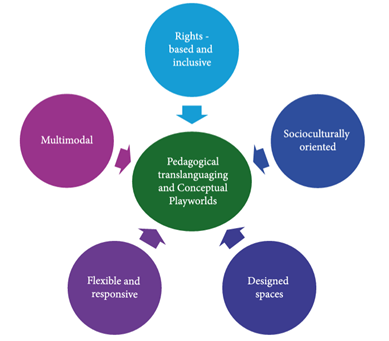
Figure 1. Common features of pedagogical translanguaging and conceptual playworlds (Oakley et al., 2025)
What are the benefits of this combined approach?
Conceptualising a translanguaging playworld pedagogy brings together the play-based approach to the early years, advocated for in leading international Frameworks (Early Years Learning Framework (Australian Government Department of Education [AGDE], 2022; Te Whariki, Ministry of Education, 2025), with translanguaging. Bringing together these two pedagogies can provide a context where language in all its forms can be valued in a meaningful way for children. From a rights-based perspective, both play and translanguaging value the child’s funds of identity as they use play to develop who they are (Leung, 2019). In this sense, a playworld translanguaging pedagogy is both flexible and responsive, where the teacher plays with the child as the narrative of the playworld is co-constructed, responding to the cues of the child in the moment.
A further benefit of this approach is the way it draws on, and uses, children’s full meaning making repertoires in a socio-culturally orientated way, emphasising the important role of both language and culture in learning through play within a specially designed space. As the children in the early years continue to be increasingly diverse, educators know more than ever the importance of drawing on practices that are socio-culturally inclusive – and playworld translanguaging provides a pedagogy for doing this.
A call to action
Playworld translanguaging is an evolving concept which the broader research team (Dr Carly Steele, Professor Toni Dobinson, Professor Sender Dovchin and Professor Wendy Cunningham-Potvin) piloted in 2024. The approach lends itself to adoption across early learning contexts by drawing on the established features of Conceptual Playworlds. Of significance is the way that bringing together the practice of pedagogical translanguaging with the playworld model can challenge our thinking on how we authentically draw on children’s language – who they are and what they know – in educational settings, without being tokenistic.
Questions for reflection
How can you envision drawing on translanguaging playworlds as a pedagogy in your own context?
How could this pedagogical approach attend not only to translanguaging, but to children’s sense of being, belonging and becoming?
- Australian Government Department of Education [AGDE], 2022. The Australian Early Years Learning Framework. AGDE.
- Fleer, M. (2018). Conceptual Playworlds: the role of imagination in play and learning. Early Years, 41(4), 353–364.
- Leung, S. (2019). Translanguaging through visual arts in early childhood: A case study in a Hong Kong kindergarten. Asia-Pacific Journal of Research, 13(1), 47–67.
- Mardell, B., Lynneth Solis, S., & Bray, O. (2019). The state of play in school: Defining and promoting playful learning in formal education settings. International Journal of Play, 8(3), 232–236.
- Ministry of Education New Zealand, (accessed 2025). .
- Oakley, G., Steele, C., Robinson, T., Dovchin, S., & Cumming-Potvin, W. (2025 online first). Towards a playworld translanguaging approach in early childhood education. Australian Review of Applied Linguistics. Find out more.
- Quinn, S.,Donnelly, S., & Kidd, E. (2018). The relationship between symbolic play and language acquisition: A meta-analytic review. Developmental Review 49, 121–135.
- Robinson, C., Treasure, T., & O’Connor, D., Neylon, G., Harrison, C. & Wynne, S. (2019). Learning through play: creating a play based approach within early childhood contexts. Oxford University Press Australia & New Zealand.
- Steele, C., Dovchin, S., & Oliver, R. (2022). ‘Stop measuring black kids with a white stick’: Translanguaging for classroom assessment. RELC Journal, 53(2), 400–415.
- UNICEF, (2018). Learning through Play.
- Zosh, J., Hassinger-Das, B. & Laurie, M. (2022). Learning through play and the development of holistic skills across childhood. Lego Foundation.