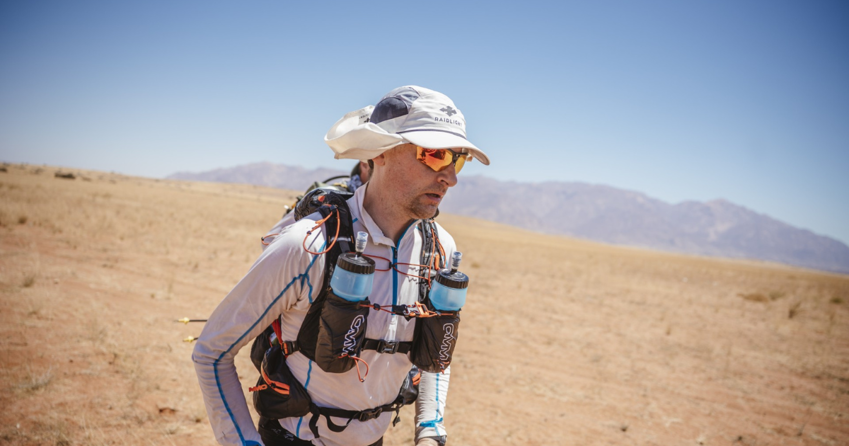
Michael Collins, Assistant Head of Sport Development at St Mary’s University, London, has successfully completed one of the toughest endurance events: a 5-day 250km self-supported ultra marathon across the Namibian desert. Covering the distance over five days, Michael finished in an impressive 4th place, in an event that historically has close to a 40% dropout rate.
The race required participants to carry everything they needed on their backs – including food, sleeping equipment, and medical supplies – while navigating temperatures reaching highs of 54 degree, long stretches of sand dunes, rocky terrain and minimal shade.
A seasoned endurance runner with over 50 marathons completed, Michael described the event as, “Undoubtedly the hardest endurance event I’ve done in my life", citing the extreme heat, constant sand running, calorie deficit, foot injuries, and sleep deprivation as significant challenges.
In the months leading up to race, Michael worked closely with St Mary’s students and staff across nutrition and physiology. Students created a day-by-day nutrition strategy in the University’s labs, modelling calorie demand, hydration schedules and pack weigh optimisation.
In the heat chamber, students tested Michael’s sweat rate and physiological response with temperatures up to 40 degrees and 51% humidity, with the weight he’ll be expected to carry, enabling them to design a precise hydration plan to prevent dehydration and overheating during the race.
Physiology students also supported him in pacing strategies and recovery planning for repeated long-distance efforts across consecutive days.
Michael says: “I was thrilled to give students this hands-on experience, which really paid off as they gave me a great plan. Their work meant I went into the race knowing exactly what to eat and when, how much to drink, and how to manage the extreme conditions. Their involvement helped me prepare physically, tactically and kept me mentally strong when things got tough out there.”
Dr James Fleming, Associate Head of School for Nutrition, said, “It was a pleasure to help Michael prepare for this race. This is an outstanding example of how our academic programmes translate research and theory into real world impact. Students have a unique opportunity to apply their knowledge, and Michael’s performance shows the strength of that collaboration. We look forward to standing alongside him once again as he prepares for his next extraordinary endeavour, the Marathon des Sables in 2026, and we cannot wait to support him every step of the way.”
The achievement highlights the University’s expertise in elite-level sport performance, sport science and applied learning opportunities.
Enquiries
For enquiries, please contact:
Press team
020 8240 8262